Abstract초록
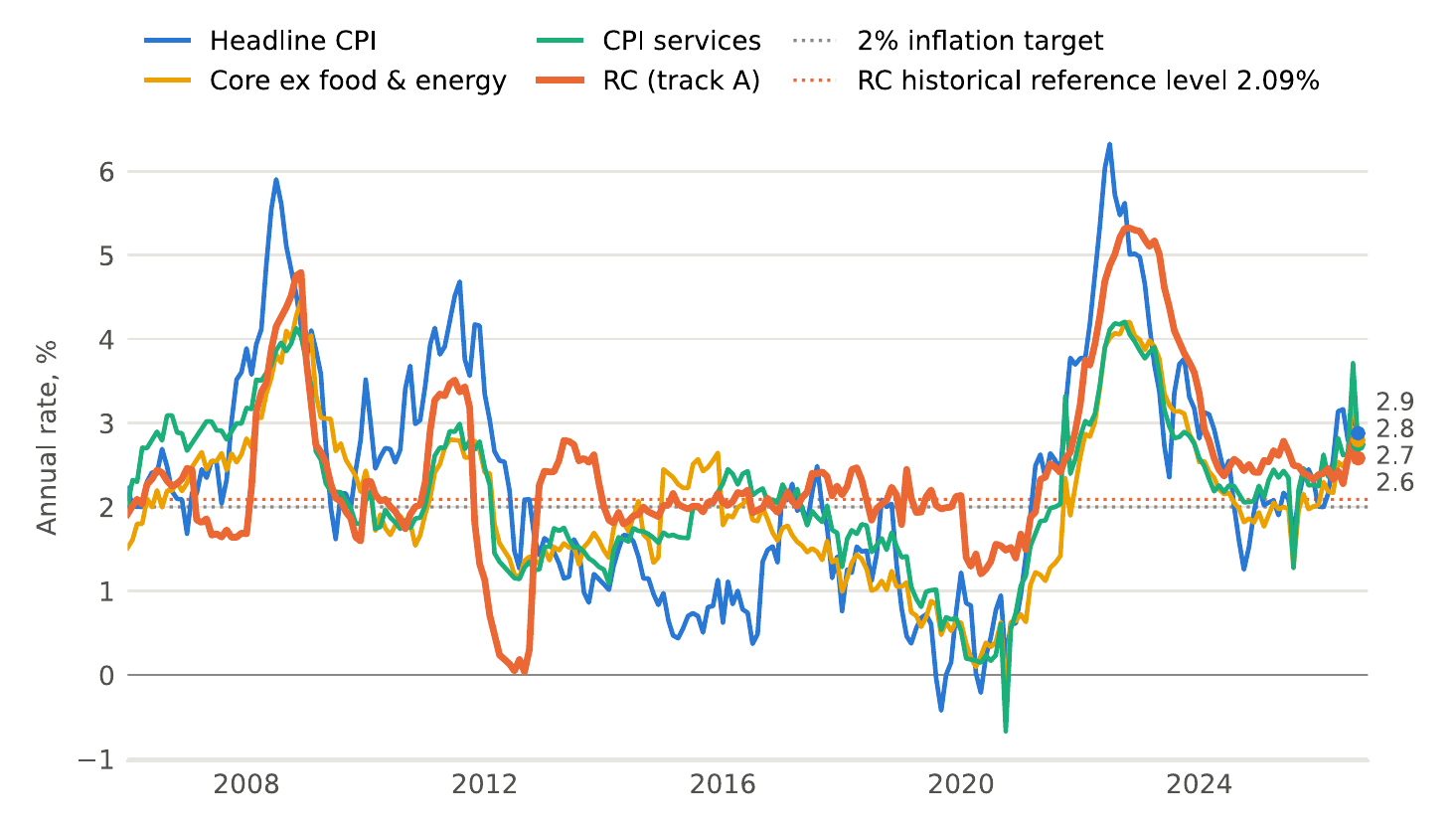
The Bank of England's measure of inflation in central sectors with rigid prices (RC) reweights consumer prices; the index it draws on, Rubbo (2023), is built from producer prices and wages. This paper asks what the consumer-price implementation measures, building both indices for Korea from public data. Korean RC (458 CPI items) was 2.58% in September 2026, against 3.03% for the same items at CPI weights and 2.88% for headline. Its largest weights are mechanical: they come from the transformation of low measured frequencies of price change and from the split of sector centrality across CPI items, and they shrink sharply with PRISMA's common product sample. The two implementations are nearly uncorrelated as built (0.08), but two artefacts of the producer-price-and-wage index (one sector priced by securities brokerage commissions, and month-to-month wage noise) account for most of this; without them the correlation is 0.49–0.59, and on the sectors both cover the remaining gap splits about evenly between prices and weights (post hoc). Of three hypotheses frozen before any test, H1 (the gap comes more from wages than from energy) is supported, but the wage share is month-to-month noise; energy contributes almost nothing because rigidity weighting removes it from both indices. Rules for administered energy tariffs move RC's average energy contribution in 2022–23 by at most 0.23pp, below the pre-set 0.3pp (H2 rejected; a peak-month reading gives 0.40pp). Korean RC shows no advantage over official measures in Phillips curves, forecasts or labour-market pressure, and in the UK it does not explain past Bank Rate decisions better than core or services inflation (H3 maintained).
영란은행의 RC 인플레이션(가격이 경직적인 중심 부문의 인플레이션)은 소비자물가를 다시 가중한 지표이고, 그 바탕이 된 Rubbo(2023)의 지수는 생산자물가와 임금으로 만들어졌습니다. 이 논문은 두 지수를 한국 공개 데이터로 모두 구축해, 소비자물가 버전이 실제로 무엇을 측정하는지 묻습니다.
한국 RC(CPI 458개 품목)는 2026년 9월 2.58%로, 같은 품목을 CPI 가중치로 묶은 값(3.03%)과 헤드라인(2.88%)보다 낮았습니다. 가장 큰 가중치들은 기계적으로 생깁니다. 측정된 가격 변경 빈도가 낮은 품목을 변환하는 과정과, 한 부문의 중심성을 CPI 품목들에 나눠 주는 과정에서 커지며, PRISMA의 공통 품목 표본을 쓰면 크게 줄어듭니다.
두 구현은 그대로는 거의 무상관(0.08)이지만, 생산자물가·임금 지수의 두 가지 인공물(증권 위탁수수료로 가격이 매겨지는 한 부문, 월별 임금 노이즈)이 대부분을 설명합니다. 이를 걷어내면 상관은 0.49~0.59이고, 두 지수가 함께 포괄하는 부문에서 남은 격차는 가격과 가중치가 거의 절반씩 나눕니다(사후 분석).
검정 전에 고정한 세 가설 중 H1(격차는 에너지보다 임금에서 더 온다)은 지지되었지만 임금 기여는 월별 노이즈입니다. 에너지는 경직성 가중이 두 지수 모두에서 제거하기 때문에 기여가 거의 없습니다. 공공요금 처리 규칙은 2022~23년 RC의 평균 에너지 기여를 최대 0.23%p만 바꿔 사전에 정한 0.3%p에 못 미칩니다(H2 기각, 최고 월 기준으로는 0.40%p). 한국 RC는 필립스 곡선, 예측, 노동시장 압력 어디에서도 공식 지표보다 나은 점이 없었고, 영국에서도 근원·서비스 물가보다 과거 기준금리 결정을 더 잘 설명하지 못했습니다(H3 유지).
원문 초록은 영어입니다. 위는 요약 번역입니다.
Pre-registered hypotheses사전 등록 가설
H1–H3, their tests and decision rules were frozen in a git-tagged commit before any test was run (Appendix B of the paper).H1~H3과 각각의 검정 방법, 판정 규칙은 어떤 검정도 돌리기 전에 git 태그 커밋으로 고정했습니다(논문 부록 B).
-
H1
Does the gap between the CPI-based RC and the producer-price-and-wage index come more from wages and intermediate services than from energy?CPI 기반 RC와 생산자물가·임금 지수의 격차는 에너지보다 임금·중간재 서비스에서 더 많이 오는가?
In an exact fixed-weight decomposition, wages account for 0.31 of the gap's variance and energy for 0.00, so the frozen rule is met. With regular pay instead of total pay, or wages smoothed over 12 months, the wage share disappears: the support comes from month-to-month noise in pay, not from an economic signal.가중치를 고정한 정확 분해에서 격차 분산의 0.31은 임금, 0.00은 에너지가 설명해 고정 규칙은 충족합니다. 하지만 총급여 대신 정기급여를 쓰거나 임금을 12개월 평활하면 임금 기여가 사라집니다. 지지는 경제적 신호가 아니라 월별 임금 노이즈에서 왔습니다.
Supported, fragile지지 (취약) -
H2
Does the energy response of Korean RC depend materially on how administered prices are treated?한국 RC의 에너지 반응은 공공요금(관리가격)을 어떻게 처리하느냐에 크게 좌우되는가?
Across five rules for the 40 administered items, the largest difference in RC's average energy contribution over 2022–23 is 0.233pp, below the 0.3pp threshold, and no rule changes the sign of the oil or gas elasticity. The frozen text does not say whether "the difference" is an average or a peak; month by month it reaches 0.40pp, which would support H2.40개 관리가격 품목에 다섯 가지 규칙을 적용했을 때 2022~23년 평균 에너지 기여의 최대 차이는 0.233%p로 기준선 0.3%p에 못 미치고, 유가·가스 탄력성의 부호를 바꾸는 규칙도 없었습니다. 다만 고정 문구가 차이를 평균으로 볼지 최고치로 볼지 정하지 않았고, 월별로 보면 0.40%p까지 벌어져 H2를 지지하게 됩니다.
Rejected on the primary reading1차 해석 기준 기각 -
H3
In the UK, does RC explain the MPC's past Bank Rate decisions better than core or services inflation?영국에서 RC는 근원·서비스 물가보다 통화정책위원회의 과거 기준금리 결정을 더 잘 설명하는가?
On 315 decisions from 1997 to 2026, RC adds nothing to core in an encompassing test (z −0.07) and forecasts decisions no better than core or services out of sample. The verdict holds in all six sensitivities. This describes revealed behaviour; it is not evidence about which indicators the Bank used.1997~2026년 315회 결정에서 RC는 포괄 검정상 근원 물가에 더하는 설명력이 없고(z −0.07), 표본 외 예측도 근원·서비스 물가보다 낫지 않았습니다. 6개 민감도 분석 모두 같은 결론입니다. 이는 드러난 결정 패턴에 대한 서술이며, 영란은행이 어떤 지표를 썼는지에 대한 증거는 아닙니다.
Maintained: RC does not explain better유지: 더 잘 설명하지 못함
Other findings그 밖의 결과
- A services index. RC has about 29.8 effective items; services carry 85.9% of its weight (55.2% of the CPI) and energy 1.2% (7.6% of the CPI).사실상 서비스 지수. RC의 유효 품목 수는 약 29.8개이고, 가중치의 85.9%가 서비스(CPI에서는 55.2%), 1.2%가 에너지(CPI에서는 7.6%)입니다.
- Mechanical weights. Health check-ups are 0.12% of the CPI but 6.4% of RC; bank fees are 0.02% of the CPI but 8.9% of RC. Excluding bank fees alone moves the September 2026 reading by +0.25pp.기계적 가중치. 건강검진은 CPI의 0.12%지만 RC에서는 6.4%, 은행 수수료는 CPI의 0.02%지만 RC에서는 8.9%입니다. 은행 수수료 하나만 빼도 2026년 9월 값이 0.25%p 올라갑니다.
- No advantage over official measures (descriptive). No measure has a significant Phillips-curve slope; adding RC to a headline benchmark raises the four-quarter-ahead forecast error by 14%; its same-quarter R² with labour-market pressure is 0.007.공식 지표 대비 우위 없음(기술 분석). 어떤 지표도 필립스 곡선 기울기가 유의하지 않고, 헤드라인 벤치마크에 RC를 더하면 4분기 앞 예측 오차가 14% 커지며, 노동시장 압력과의 동분기 R²는 0.007입니다.
Main limitation주요 한계
Price rigidity is imported. Korea has no public micro-data on how often prices change, so both Korean indices rest on euro-area (PRISMA, 2010–19) and US (Pasten–Schoenle–Weber, 2005–11) frequencies. The paper lists this and the other limitations in Section 8.가격 경직성을 외부에서 빌려왔습니다. 한국에는 가격 변경 빈도에 관한 공개 미시자료가 없어, 두 한국 지수 모두 유로 지역(PRISMA, 2010~19년)과 미국(Pasten–Schoenle–Weber, 2005~11년)의 빈도를 씁니다. 이 밖의 한계는 논문 8절에 정리했습니다.
Cite this paper인용
Kim, D. (2026). "What Does Rigid-Central Inflation Measure? Building Both Versions for Korea." Working paper, Deepthought. https://deepthought42lab.com/research/korea-rc/
@techreport{kim2026rc,
  author      = {Kim, Doyoung},
  title       = {What Does Rigid-Central Inflation Measure? Building Both Versions for Korea},
  institution = {Deepthought},
  type        = {Working Paper},
  year        = {2026},
  month       = oct,
  url         = {https://deepthought42lab.com/research/korea-rc/}
}
Notes고지
This paper has not been peer reviewed. It is prepared for academic research purposes only; the views are solely those of the author and nothing in it constitutes investment advice.이 논문은 동료 심사를 거치지 않았습니다. 학술 연구 목적으로 작성되었으며, 견해는 저자 개인의 것이고 어떤 내용도 투자 권유가 아닙니다.
AI use: the author used Anthropic Claude to write and run the analysis code, produce the figures and tables, and draft and edit the text. The author directed the research questions, the pre-registered hypotheses and the design choices, reviewed and edited the output, and takes full responsibility for the content.AI 사용: 저자는 분석 코드 작성과 실행, 그림·표 작성, 본문 초안과 편집에 Anthropic의 Claude를 사용했습니다. 연구 질문, 사전 등록 가설, 설계 선택은 저자가 정했고, 결과물을 검토·수정했으며 내용에 대한 책임은 저자에게 있습니다.